
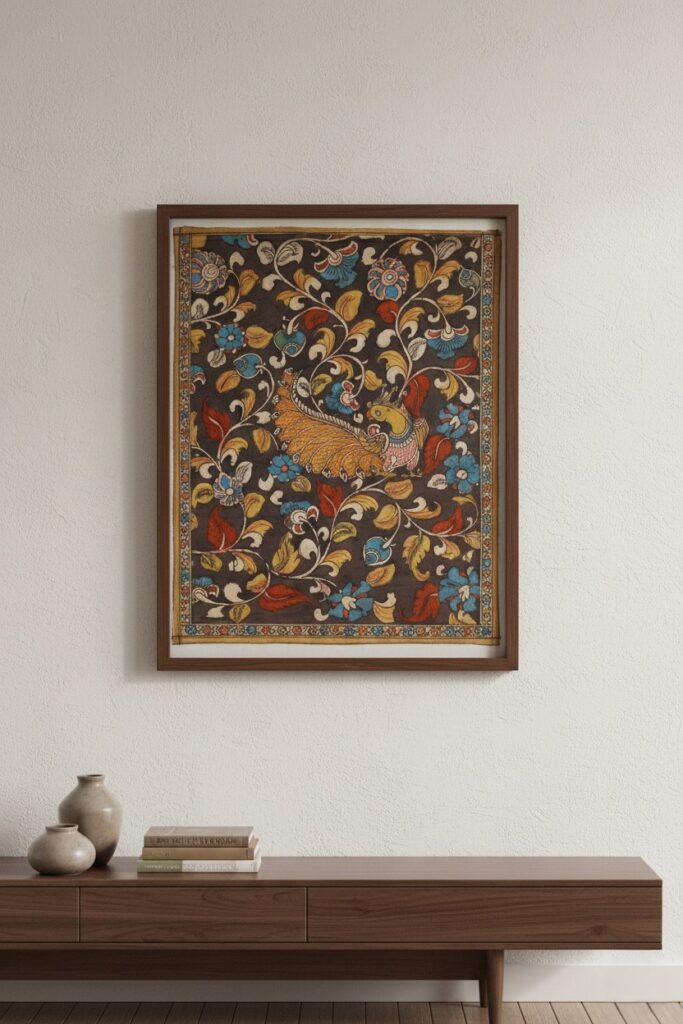
Traditional Kalamkari paintings
Traditional Kalamkari is one of the most celebrated Indian traditional paintings, recognised for its detailed hand-drawn and hand-printed narratives on textiles. Among Indian traditional paintings, Kalamkari stands out for its use of the kalam (pen) and carved wooden blocks to create intricate compositions inspired by mythology, epics, temple traditions, and nature. This narrative-driven style places Kalamkari firmly within the lineage of Indian traditional paintings, where storytelling and craftsmanship are central. The use of natural dyes is a defining feature of Indian traditional paintings, including Kalamkari. Cotton fabric is carefully prepared and dyed using plant- and mineral-based pigments such as black from iron solutions, red from alum, blue from indigo, and yellow from botanical sources. Each colour requires precise application and repeated washing to achieve lasting depth and clarity. Like many Indian traditional paintings, Kalamkari involves a long and highly methodical process with multiple stages of drawing, dyeing, washing, and drying. Depending on the complexity of the work, a single piece may take several weeks to complete. This dedication to time, skill, and natural materials ensures Kalamkari remains a vital expression of Indian traditional paintings and their enduring cultural value.
Pingback: Traditional Mural Paintings of Kerala